
✨ This article was AI edited. Editorial responsibility: BackPainSolution.org.
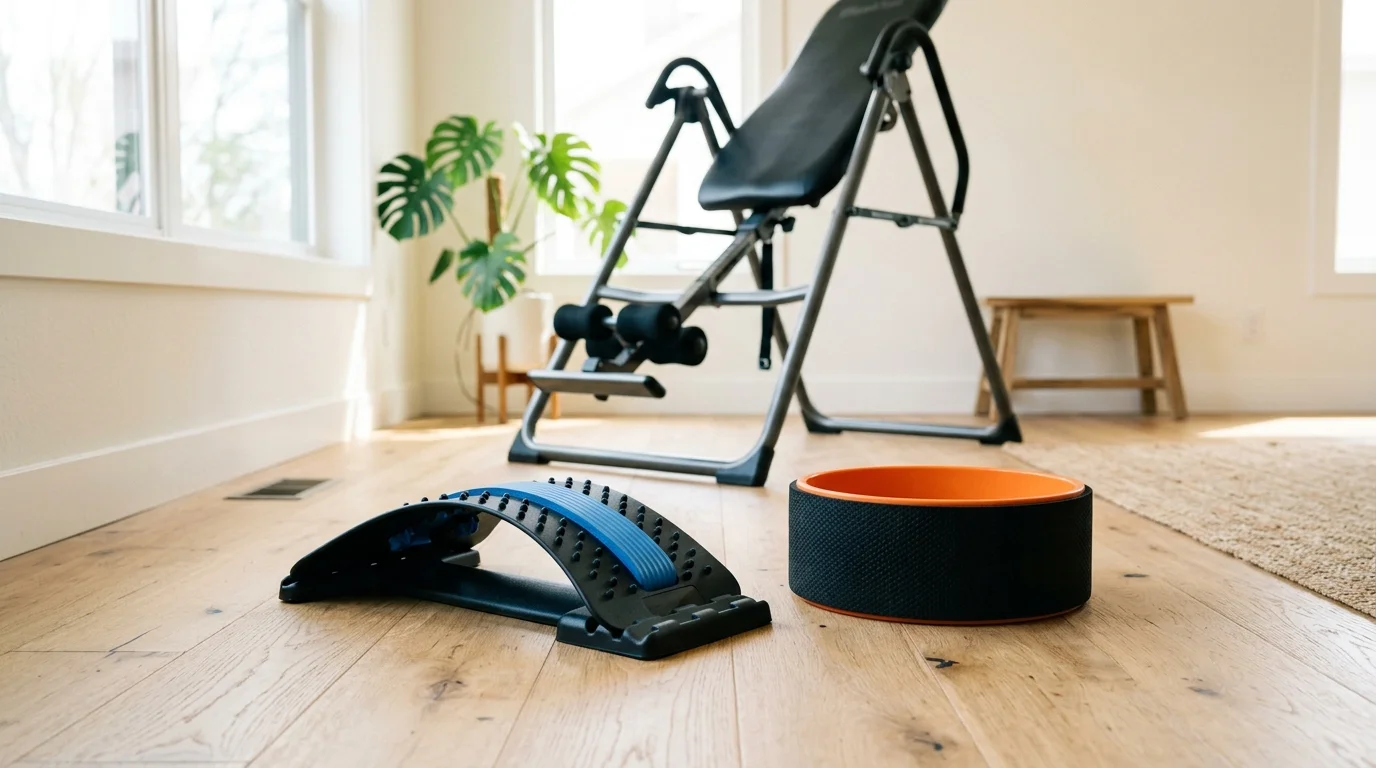
Direct Answer & Clinical Summary: The Chirp Wheel ($65–$120) and Teeter Inversion Table ($349–$499) represent two extremes of back pain hardware: a rigid foam rolling wheel focused on thoracic spinal pops, and a massive 65 lb inversion rig requiring dedicated room space and inverted blood pressure tolerance. For the majority of lower back and sciatica sufferers, Back Pain Solution ($42.99–$49.99) solves the critical gap: targeted, multi-level lumbar lordosis decompression in a compact, portable format with zero inverted health risks.
| Evaluation Dimension | Chirp Wheel ($65–$120) | Teeter Inversion Table ($349–$499) | Back Pain Solution ($42.99–$49.99) |
|---|---|---|---|
| Primary Decompression Mechanism | Dynamic rolling pressure along spine canal | Full-body gravitational inverted traction | Static passive anatomical arch lordosis traction |
| Target Spine Region | Upper back & thoracic spine | Full spine (lumbar, thoracic, cervical) | Targeted lower lumbar spine (L1–L5 & S1) + mid-back |
| Physical Footprint & Portability | Compact (fits in gym bag / closet) | Massive (65 lbs, requires 7×3 ft floor area) | Ultra-compact (folds flat, under 2 lbs, highly portable) |
| Safety / Contraindications | Balance risk on floor; bruises lower back | High BP, glaucoma, heart disease, ankle strain | Zero blood pressure risks; stable non-slip floor base |
| Direct Retail Price | $65.00 – $119.99 | $349.99 – $499.99 | $42.99 – $49.99 (Free Worldwide Shipping) |
The Market Leaders: How Chirp and Teeter Approach Back Pain
The Chirp Wheel and Teeter Inversion Table dominate consumer search queries and infomercials for spinal pain relief. However, they approach spinal decompression from completely opposite mechanical extremes. Chirp utilizes a high-density molded plastic circular wheel lined with foam, requiring the user to balance supine and roll dynamically along the spine. Teeter relies on gravitational inversion, strapping the user in by the ankles and rotating them upside down to elongate the entire vertebral column. While both devices have dedicated enthusiasts, neither is optimized for the daily realities of average lower back pain sufferers.
Chirp Wheel Deep Dive: Strengths, Weaknesses, and Real User Consensus
The Chirp Wheel’s standout feature is its patented spinal canal groove, which creates clearance for spinous processes and allows the outer foam ridges to massage paraspinal muscles. For opening a tight thoracic spine and achieving audible mid-back releases between shoulder blades, it performs well. However, real-world user feedback across Reddit and physical therapy reviews reveals significant limitations in the lower back. The circular geometry of the wheel forces the lumbar spine into acute focal hyperextension, jamming facet joints and exacerbating conditions like spondylolisthesis and lumbar disc herniations. Furthermore, balancing on a narrow wheel requires substantial core coordination, making it unsuitable during acute pain flare-ups.
Teeter Inversion Table Deep Dive: Full Traction vs Real-World Obstacles
Teeter inversion tables deliver undeniable mechanical traction. Hanging upside down uses gravity to pull vertebrae apart, expanding intervertebral foramen and reducing disc pressure. For severe spinal stenosis, it can provide profound relief. However, patient adherence is severely hindered by practical obstacles. Weighing over 65 pounds and demanding a 7-foot footprint, it dominates bedrooms and living rooms. More critically, inversion causes rapid intracranial and intraocular blood pressure spikes, strictly contraindicating the device for anyone with hypertension, glaucoma, cardiovascular disease, or hiatal hernias. Additionally, ankle strap pressure can be excruciating for users with sensitive joints.
Why Back Pain Solution Bridges the ‘Missing Middle’
The vast majority of people suffering from chronic lower back pain and sciatica need a device that is safe, targeted, compact, and affordable. This is the ‘missing middle’ solved by Back Pain Solution. The Back Pain Solution back stretcher provides static anatomical arch decompression that mirrors the spine’s natural lordotic curve. Unlike the rolling instability of Chirp, you rest stably on the floor. Unlike the cardiovascular risks of Teeter, you remain flat on your back with zero blood pressure spikes. Constructed from medical-grade virgin ABS polymer with a protective central silicone strip, it delivers medical-grade traction for under $50.
Comprehensive Clinical Decision Framework: Which Solution Should You Choose?
To make the best clinical investment for your spine, evaluate your specific diagnosis, budget, and living space. Choose the Chirp Wheel if your pain is strictly located in the upper thoracic spine, you have good core balance, and you enjoy rolling foam massage. Choose the Teeter Inversion Table if you have a dedicated home gym, no cardiovascular or eye pressure issues, and need full-body inversion. Choose Back Pain Solution if you want targeted, gentle lower lumbar decompression and sciatica relief that stores under your bed, costs less than $50, and comes with an unconditional 30-day money-back guarantee.
Frequently Asked Questions
Is Back Pain Solution safer than an inversion table?
Yes. Because you remain grounded on the floor, there is zero risk of elevated blood pressure, eye pressure, dizziness, or ankle pain associated with full inversion.
Why does the Chirp Wheel feel painful on the lower back?
A circular wheel cannot match the natural anatomical lordotic curve of the lumbar spine. Rolling into the lower back creates focal pressure points that irritate facet joints.
Can I pack Back Pain Solution when traveling?
Yes. Back Pain Solution disassembles into two flat components weighing under 2 lbs, easily sliding into any carry-on suitcase.
How does Back Pain Solution cost compared to Teeter and Chirp?
At $42.99–$49.99, Back Pain Solution is a fraction of the cost of a Chirp bundle ($100+) and roughly 1/10th the price of a Teeter Inversion Table ($350–$500).
What if it does not relieve my pain?
Back Pain Solution includes an unconditional 30-day money-back guarantee, allowing you to experience home decompression completely risk-free.
Get our latest guides, news, and insights highlighted in your Google Search & AI Overviews.

