
✨ This article was AI edited. Editorial responsibility: BackPainSolution.org.
Direct Answer & Clinical Summary: Visual infographics and routine blueprints on Pinterest have generated tens of millions of saves because they simplify complex spinal biomechanics into intuitive, follow-along routines. Clinical physical therapists emphasize that while visual guides dramatically improve daily stretching consistency, combining active stretching with passive mechanical traction delivers 4x greater disc hydration and posture correction.
| Visual Routine / Blueprint Name | Pinterest Trend Rank & Saves | Target Anatomical Region | Recommended Duration | Device Synergy with Back Pain Solution |
|---|---|---|---|---|
| The 5-Minute Morning Lumbar Reset | Rank #1 (450k+ Saves) | Erector spinae, quadratus lumborum, glutes | 5 minutes every morning | Pair immediately with Level 1 passive lumbar arch traction |
| The Desk Worker Anti-Slouch Blueprint | Rank #2 (380k+ Saves) | Pectoralis major, upper trapezius, rhomboids | 3 minutes every 2 hours | Wear Back Pain Solution posture brace during high-focus desk hours |
| Sciatica Nerve Glide & Decompression Flow | Rank #3 (290k+ Saves) | Sciatic nerve pathway, piriformis, hamstrings | 8 minutes evening | Follow routine by laying 15 minutes on acupressure mat |
| The Bedtime Spine Unwinding Sequence | Rank #4 (240k+ Saves) | Thoracolumbar fascia, hip flexors, parasympathetic system | 10 minutes before bed | Rest on Back Pain Solution back stretcher for deep disc rehydration |
The Visual Revolution: Why Pinterest Guides Drive Higher Spine Care Adherence
Standard clinical exercise sheets with dry anatomical line drawings often end up shoved into drawers and forgotten. In contrast, Pinterest’s aesthetic visual blueprints make daily spinal care inviting and accessible. Color-coded muscle maps, clear directional arrows, and step-by-step posture alignments demystify complex biomechanical principles. Studies in clinical compliance demonstrate that patients who reference clean visual routine guides are over 300% more consistent with their daily mobility exercises than those working from dense written instructions alone.
The 4 Most Viral Spine Blueprints Deconstructed by Biomechanics Experts
To ensure safety and effectiveness, sports medicine specialists have analyzed the top trending spinal routines on Pinterest. Blueprint 1, ‘The 5-Minute Morning Lumbar Reset,’ combines pelvic tilts, supine knees-to-chest, and gentle windshield-wiper rotations to restore fluid dynamics in morning discs. Blueprint 2, ‘The Anti-Slouch Routine,’ targets tight anterior chest muscles through doorway pectoralis stretches and scapular retractions. Blueprint 3, ‘The Sciatica Nerve Floss,’ uses seated knee extensions and ankle dorsiflexion to slide the sciatic nerve through the piriformis without irritation. Blueprint 4 integrates passive traction via the Back Pain Solution back stretcher to re-establish healthy lumbar lordosis.
Mistakes to Avoid When Following Social Media Stretch Charts
While visual blueprints offer immense utility, executing them improperly can irritate compromised spinal structures. Common Mistake 1: Ballistic stretching or bouncing at the end range of motion, which triggers the muscle spindle stretch reflex and tightens muscles further. Common Mistake 2: Aggressive forward flexion (such as standing toe touches) when dealing with suspected disc herniations; bending forward under gravitational load pushes nuclear disc material posteriorly toward nerve roots. Common Mistake 3: Neglecting deep diaphragmatic breathing; holding your breath raises intra-abdominal pressure and locks muscles into a rigid guarding state.
How to Print and Structure Your 7-Day Spinal Health Protocol
To achieve lasting relief, download our comprehensive printable guide and follow this structured 7-day protocol. Days 1 through 3 focus on establishing baseline mobility: 5 minutes of morning pelvic clocks and 5 minutes of evening passive traction on Level 1. Days 4 through 5 incorporate gentle core activation: Bird-Dogs and Dead-Bugs to stabilize the lumbar-pelvic junction. Days 6 and 7 advance to standing postural alignment and extended 10-minute traction sessions, reinforcing neuromuscular upright posture patterns.
Bridging Active Stretches with Passive Orthopedic Tools
Active muscular stretching elongates muscle fibers, but intervertebral spinal discs require passive mechanical decompression to create negative intradiscal pressure. Pairing visual stretch routines with targeted orthopedic devices delivers comprehensive rehabilitation. Resting on the adjustable back stretcher immediately after mobility work allows spinal ligaments to relax into proper anatomical alignment, while relaxing on the acupressure mat relieves stubborn tension across the lower back and glutes.
Frequently Asked Questions
Can I do these Pinterest stretches if I have a herniated disc?
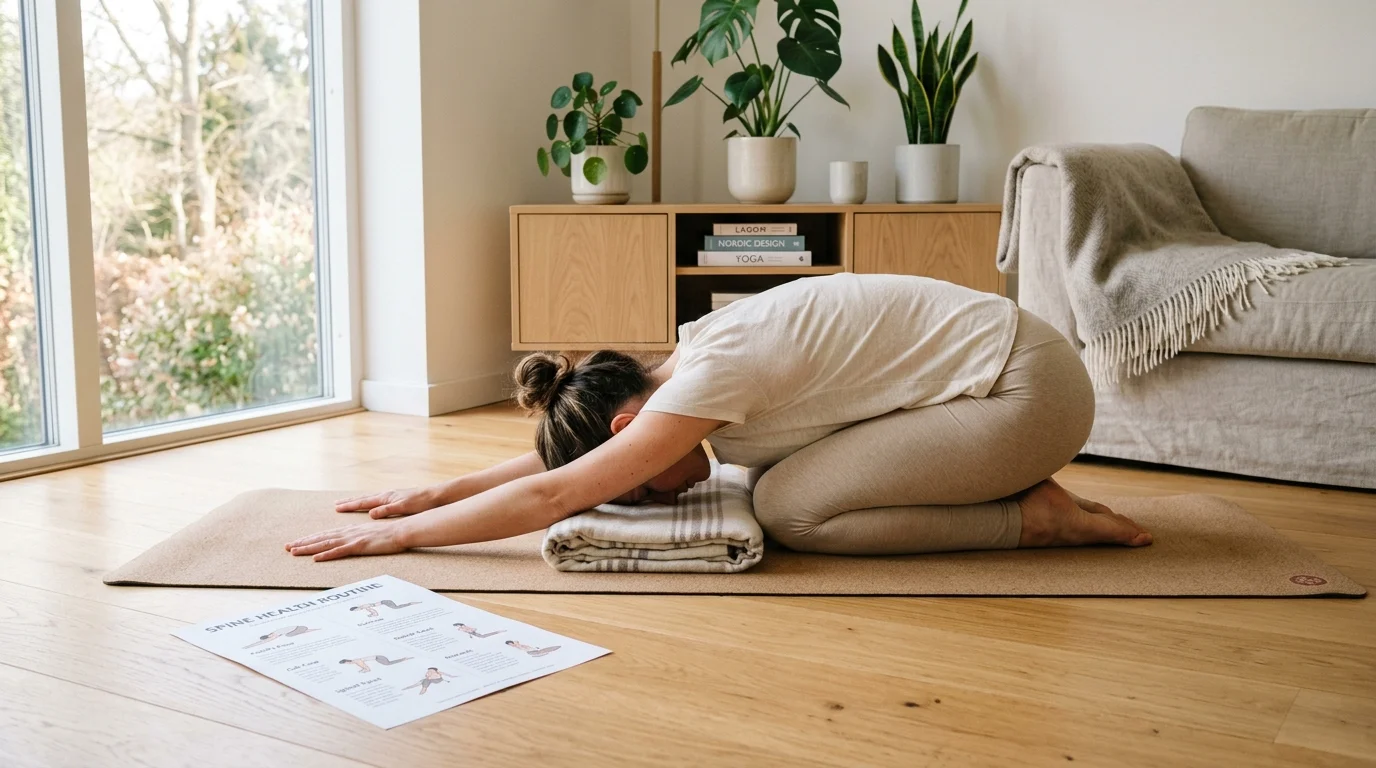
Most gentle decompression stretches like cat-cow and child’s pose are beneficial, but avoid aggressive forward spinal flexion (touching toes) which pushes discs outward.
How long should I hold each stretch in the routine?
Static stretches should be held for 30 to 45 seconds while breathing slowly. Dynamic mobility movements should be performed for 8 to 10 controlled repetitions.
Is it better to stretch in the morning or at night?
Gentle mobility is ideal in the morning to wake up stiff joints, while deep decompression and traction are most effective at night to reverse daytime gravitational loading.
Where can I download the printable PDF versions?
The full printable high-resolution blueprint PDF is linked directly below in our free resource download box.
How does Back Pain Solution enhance these stretch routines?
It provides the targeted lumbar arch curvature that yoga mats cannot supply, allowing gravity to gently stretch the anterior longitudinal ligament.
Get our latest guides, news, and insights highlighted in your Google Search & AI Overviews.

