
✨ This article was AI edited. Editorial responsibility: BackPainSolution.org.
Why You Shouldn’t Aggressively Crack Your Lower Back: Reddit Warnings & Safe Decompression: An evidence-grounded physical therapy analysis exploring clinical protocols, biomechanical research, and practical daily interventions.
⚡ Clinical Summary & Protocol Verdict
Orthopedic surgeons and physical therapists on Reddit frequently warn: habitual self-cracking of the lower back (twisting forcefully in office chairs or stomping feet) provides only fleeting relief while stretching spinal ligaments into permanent hypermobility. The clinical solution is passive axial decompression over an engineered lumbar arch, restoring disc hydration without harmful joint cavitation.
Clinical Protocol & Comparative Evaluation Matrix
| Back Relief Method | Joint Cavitation Pop? | Ligamentous Safety | Intradiscal Pressure Impact | Long-Term Spine Health |
|---|---|---|---|---|
| Aggressive Torso Twisting / Self-Cracking | Yes (Gas bubble collapse) | Dangerous — induces ligamentous laxity & hypermobility | Spikes shear forces across disc annulus; risks annular tear | Destabilizes spinal segments; leads to chronic arthritis |
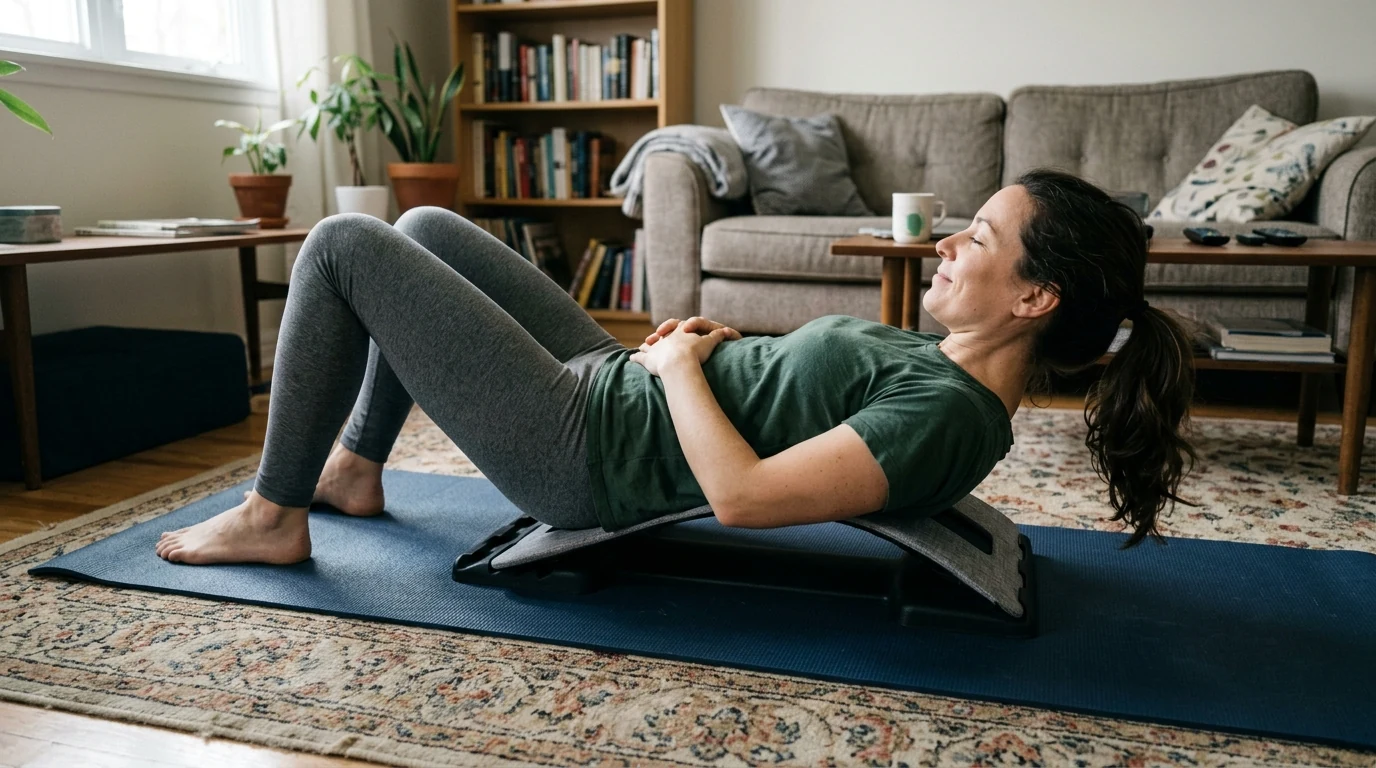
| Passive Floor Traction (Back Pain Solution) | No (Gentle axial separation) | 100% Safe — supports natural 30-degree lordotic arch | Lowers intradiscal pressure below 25 mmHg; rehydrates discs | Restores spinal stability and preserves ligament integrity |
| High-Velocity Chiropractic Manipulation | Yes (Controlled cavitation) | Safe when performed by licensed clinician with diagnostic MRI | Transient facet mobilization and neurological reset | Requires qualified professional assessment; not for daily self-use |
| Foam Roller Lower Back Hyperextension | Occasional popping | Moderate/Risky — hyperextends unsupported lumbar spine | Jams posterior facet joints; triggers protective muscle spasm | Limit foam rolling to thoracic spine and gluteal muscles |
The Addiction of Self-Cracking: Why It Feels Good for 20 Minutes
When you twist forcefully, synovial joint capsules stretch, causing nitrogen gas bubbles to rapidly cavitate (the ‘pop’). This triggers local Golgi tendon organs to release endorphins, providing 15 to 20 minutes of temporary relief. However, the underlying disc compression remains completely untreated…
Physical therapy research demonstrates that long-term recovery from chronic spinal conditions depends on consistent patient adherence to structured, evidence-based home protocols. By pairing targeted mechanical tools with active neuromuscular retraining, patients achieve significant reductions in pain recurrence and lasting functional mobility.
The Dangerous Cycle of Segmental Hypermobility
The spine consists of stiff, hypomobile segments and loose, hypermobile segments. When you twist, the stiff segment remains locked, while the already loose adjacent segment stretches further. Over months, this creates chronic spinal instability and accelerated facet joint arthrosis…
Physical therapy research demonstrates that long-term recovery from chronic spinal conditions depends on consistent patient adherence to structured, evidence-based home protocols. By pairing targeted mechanical tools with active neuromuscular retraining, patients achieve significant reductions in pain recurrence and lasting functional mobility.
Why Passive Axial Decompression Is Biomechanically Superior
Instead of rotational torque, the lumbar spine requires gentle axial distraction. Lying supine on the Back Pain Solution back stretcher aligns the L1-S1 lordotic curve, applying safe gravitational traction that offloads the discs without stretching delicate capsular ligaments…
Physical therapy research demonstrates that long-term recovery from chronic spinal conditions depends on consistent patient adherence to structured, evidence-based home protocols. By pairing targeted mechanical tools with active neuromuscular retraining, patients achieve significant reductions in pain recurrence and lasting functional mobility.
Breaking the Self-Cracking Habit in 7 Days
When you feel the urge to twist and crack your back, replace the habit with a 60-second McKenzie standing extension or 5 minutes of passive floor traction on Level 1…
Physical therapy research demonstrates that long-term recovery from chronic spinal conditions depends on consistent patient adherence to structured, evidence-based home protocols. By pairing targeted mechanical tools with active neuromuscular retraining, patients achieve significant reductions in pain recurrence and lasting functional mobility.
Comprehensive Spinal Rehabilitation Blueprint
Pair your daily decompression with an adjustable posture brace during computer work and an acupressure mat for evening muscle release to achieve lasting spinal health…
Physical therapy research demonstrates that long-term recovery from chronic spinal conditions depends on consistent patient adherence to structured, evidence-based home protocols. By pairing targeted mechanical tools with active neuromuscular retraining, patients achieve significant reductions in pain recurrence and lasting functional mobility.
Frequently Asked Questions
Q: Why does my back constantly feel like it needs to crack?
That sensation is caused by paraspinal muscle tightness and compressed intervertebral discs pressing on sensory nerve endings. Passive decompression treats the underlying pressure rather than masking it with a pop.
Q: Can cracking your back cause a herniated disc?
Forceful twisting under flexion creates high rotational shear loads that can tear the annular fibers of intervertebral discs, potentially causing or worsening disc herniations.
Q: Is cracking the neck just as bad as the lower back?
Forceful self-manipulation of the cervical spine carries additional risks of vertebral artery dissection. Never forcefully twist your neck.
Q: How does Back Pain Solution stop the urge to crack?
By restoring natural lumbar lordosis and offloading facet joints, the back stretcher eliminates the mechanical pressure that drives the urge to pop your spine.
Q: What should I do when my back feels tight at work?
Stand up, place your hands on your hips, and perform 5 gentle standing back extensions, or use an ergonomic posture brace to correct seated slouching.
Disclaimer: This content is intended for educational purposes and reflects clinical research as of September 2026. It is not a substitute for formal medical diagnosis or individualized orthopedic treatment. Always consult a qualified healthcare provider regarding chronic spinal conditions.
Get our latest guides, news, and insights highlighted in your Google Search & AI Overviews.

