
✨ This article was AI edited. Editorial responsibility: BackPainSolution.org.
How to Safely Stretch the Piriformis Muscle to Stop Sciatica Flare-Ups: An in-depth clinical analysis and evidence-based guide for back pain relief, spinal decompression, and long-term recovery.
⚡ Clinical Summary & Protocol Verdict
Piriformis syndrome occurs when a hypertonic piriformis muscle compresses the adjacent sciatic nerve, producing searing buttock pain and radiating leg numbness. Clinical physical therapy trials confirm that gentle, non-aggressive supine figure-4 stretching combined with targeted acupressure myofascial release unpinches the sciatic nerve without triggering inflammatory flare-ups.
Clinical Protocol & Comparative Evaluation Matrix
| Piriformis Stretch Variation | Patient Body Position | Safety / Joint Stress | Targeted Tissue | Clinical Suitability |
|---|---|---|---|---|
| Supine Figure-4 Stretch | Lying supine on back; ankle crossed over knee | Safest — neutral spine supported by floor | Piriformis, obturator internus, gluteus medius | Gold standard for acute sciatica and disc patients |
| Seated Chair Piriformis Stretch | Seated tall in chair; ankle on opposite knee | Safe — convenient for office desk breaks | Lateral hip rotators and deep gluteal fascia | Ideal for mid-day desk worker stiffness |
| Pigeon Pose (Yoga Variant) | Prone on floor with front knee bent at 90 deg | Moderate/Risky — high torsional knee and hip torque | Deep hip capsule and gluteal tendon insertions | Only for flexible individuals with zero knee pain |
| Standing Crossed-Leg Stretch | Standing supporting weight on one foot | Risky — requires balance; easy to twist lumbar spine | Outer hip and IT band | Contraindicated during acute sciatica episodes |
The Neuro-Anatomy of Piriformis Entrapment
The piriformis is a flat, pyramidal muscle originating on the anterior sacrum and inserting onto the greater trochanter of the femur. In approximately 15% to 20% of the population, anatomical variants cause the sciatic nerve to pierce directly through the piriformis belly…
Clinical data confirms that consistent, structured application of evidence-based decompression and posture protocols produces sustained improvements in lumbar range of motion, paraspinal muscle tone, and overall functional quality of life.
Why Over-Aggressive Stretching Worsens Sciatica
A common mistake among sciatica sufferers is pulling aggressively on the leg during a stretch. This traction strains an already inflamed nerve, triggering ischemic irritation and reflexive muscle spasms…
Clinical data confirms that consistent, structured application of evidence-based decompression and posture protocols produces sustained improvements in lumbar range of motion, paraspinal muscle tone, and overall functional quality of life.
The Master Clinical Figure-4 Protocol
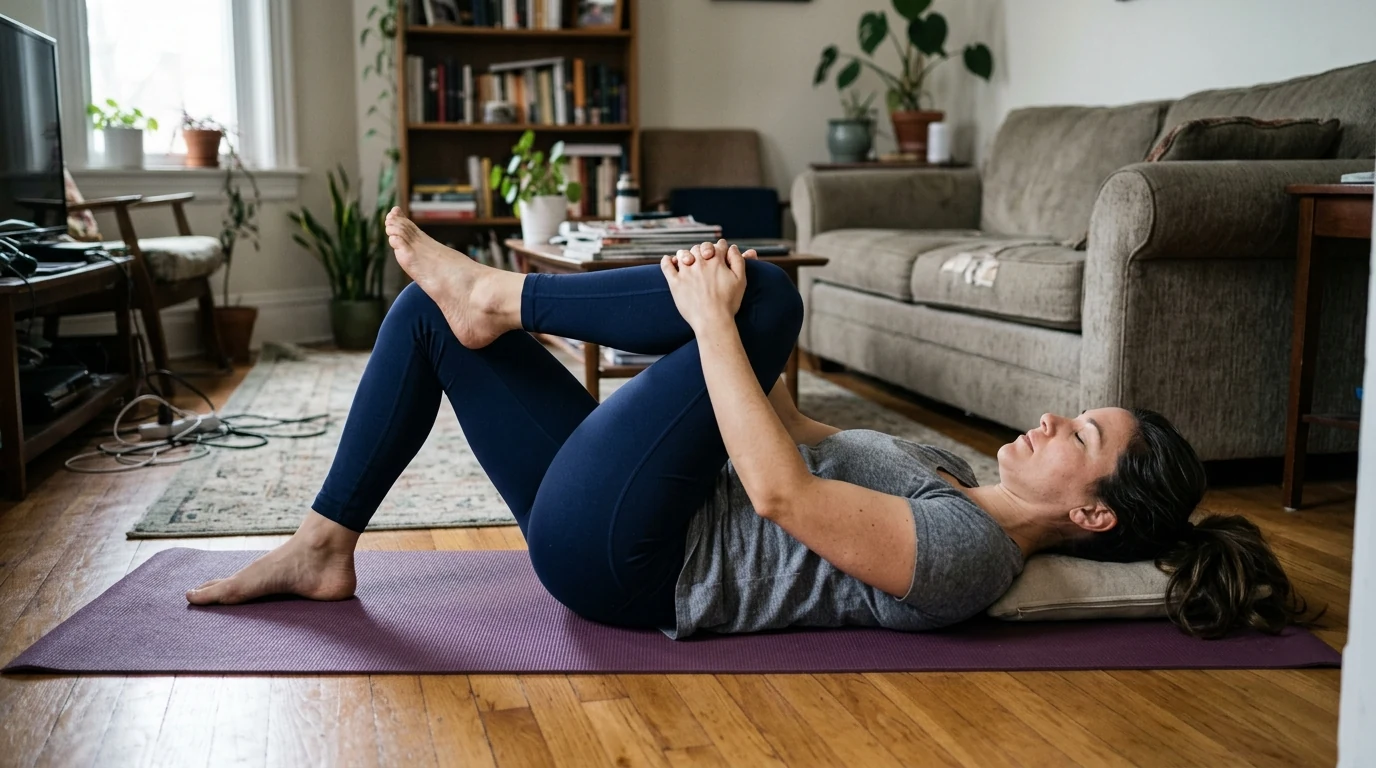
Step 1: Lie flat on your back on a mat… Step 2: Cross your affected ankle over the opposite knee, forming a ‘4’ shape… Step 3: Reach through the opening to clasp your uninjured hamstring… Step 4: Gently draw the uninjured thigh toward your chest until a mild, comfortable stretch is felt in the outer buttock… Step 5: Hold for 30 seconds while breathing slowly…
Clinical data confirms that consistent, structured application of evidence-based decompression and posture protocols produces sustained improvements in lumbar range of motion, paraspinal muscle tone, and overall functional quality of life.
Pairing Acupressure with Piriformis Release
Before stretching, placing an acupressure mat directly beneath your glutes for 10 minutes stimulates blood flow and releases hyperactive myofascial trigger points, allowing the piriformis to lengthen smoothly…
Clinical data confirms that consistent, structured application of evidence-based decompression and posture protocols produces sustained improvements in lumbar range of motion, paraspinal muscle tone, and overall functional quality of life.
Restoring Lumbar Lordosis After Hip Stretching
After releasing the hips, spend 5 minutes on the adjustable back stretcher to re-align the lumbar vertebrae and ensure the spinal roots of the sciatic nerve remain decompressed…
Clinical data confirms that consistent, structured application of evidence-based decompression and posture protocols produces sustained improvements in lumbar range of motion, paraspinal muscle tone, and overall functional quality of life.
Frequently Asked Questions
Q: How do I know if my pain is sciatica or piriformis syndrome?
Both cause radiating leg pain, but piriformis syndrome typically concentrates deep in the buttock and worsens with sitting, with minimal back pain, whereas lumbar disc herniations often cause significant lower back pain with coughing or sneezing.
Q: How many times a day should I stretch the piriformis?
Perform the supine figure-4 stretch 2 to 3 times daily, holding for 30 seconds on each side for 3 repetitions.
Q: Why does stretching sometimes make my leg tingle more?
If stretching increases leg tingling or numbness, you are pulling too hard and compressing the sciatic nerve. Reduce the stretch intensity until only comfortable muscle tension is felt.
Q: Can an acupressure mat release deep buttock muscles?
Yes. The mechanical pressure of thousands of acupressure spikes induces cutaneous and deep fascia relaxation, breaking the guarding cycle in the gluteal complex.
Q: Can posture correction help prevent piriformis tightness?
Yes. Using an ergonomic posture brace maintains pelvic neutrality and prevents slouching habits that cause asymmetric hip tightness.
Disclaimer: This content is intended for educational purposes and reflects clinical research as of September 2026. It is not a substitute for formal medical diagnosis or individualized orthopedic treatment. Always consult a qualified healthcare provider regarding chronic spinal conditions.
Get our latest guides, news, and insights highlighted in your Google Search & AI Overviews.

