
✨ This article was AI edited. Editorial responsibility: BackPainSolution.org.
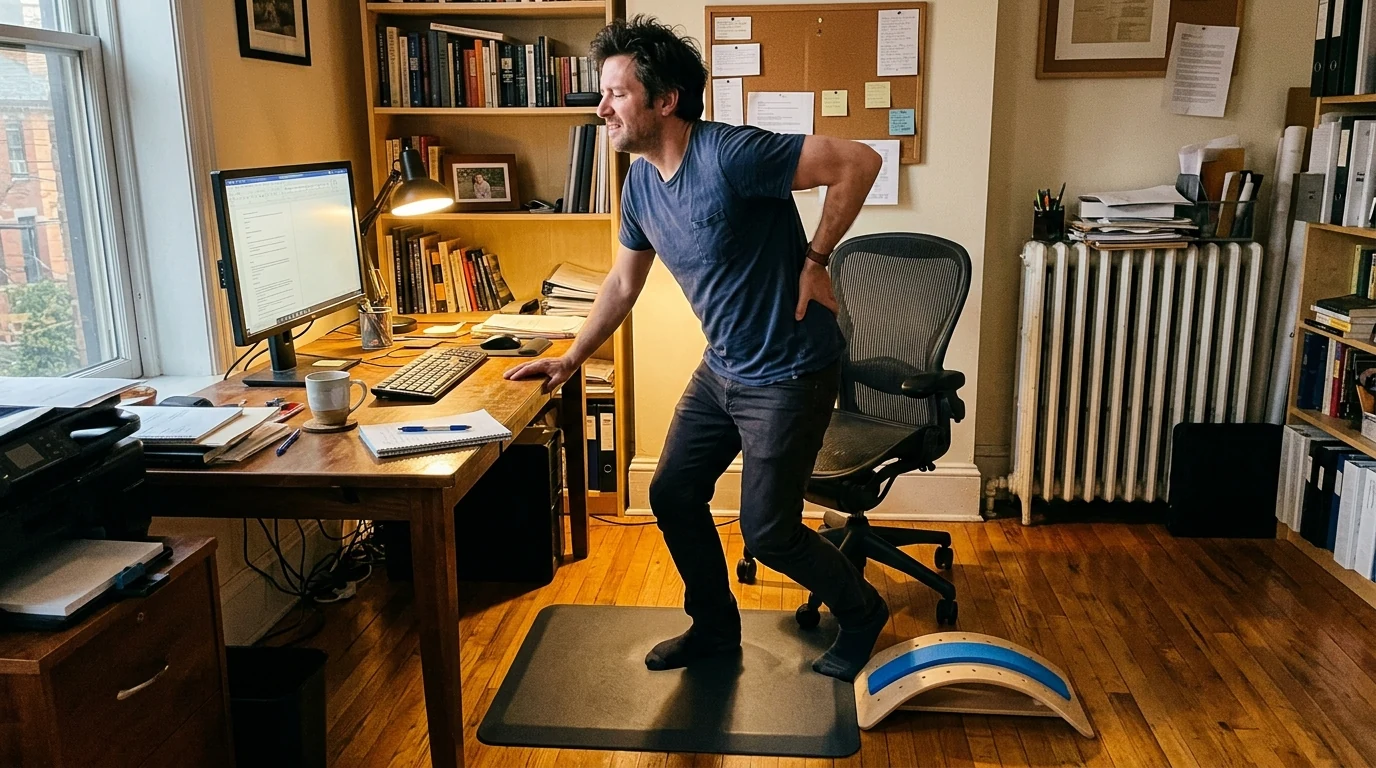
How to Relieve Lower Back Stiffness After Sitting All Day for Desk Workers: An in-depth clinical analysis and evidence-based guide for back pain relief, spinal decompression, and long-term recovery.
⚡ Clinical Summary & Protocol Verdict
Prolonged 8-to-10-hour chair sitting triggers ligamentous creep, shortens the psoas major, and elevates intradiscal pressure to 180 mmHg. The clinical 4-step decompression routine reverses anterior disc wedging, restores lumbar lordosis, and breaks paraspinal muscle spasms in under 12 minutes without pharmaceuticals.
Clinical Protocol & Comparative Evaluation Matrix
| Post-Work Routine Step | Target Anatomy | Prescribed Time | Biomechanical Objective | Patient Sensations |
|---|---|---|---|---|
| Step 1: Standing Pelvic Hinging | Iliopsoas & anterior hip capsule | 90 seconds per side | Opens shortened hip flexors preventing forward tilt | Deep stretch across front of hip and groin |
| Step 2: Passive Floor Arch Traction | L1-S1 intervertebral discs & lordosis | 5–8 minutes on Level 1 | Applies gentle axial decompression to rehydrate discs | Gentle opening sensation; pressure drops off sacrum |
| Step 3: Supine Knee-to-Chest Rocking | Quadratus lumborum & gluteal fascia | 2 minutes rhythmic rocking | Gently mobilizes lumbar facet joints and sacral base | Pleasant release of tension in lower back bands |
| Step 4: Acupressure Endorphin Reset | Erector spinae & thoracolumbar fascia | 10–15 minutes on spike mat | Induces cutaneous vasodilation and muscle relaxation | Deep warming flush; tension headaches dissipate |
The Pathology of Seated Creep: Why Your Back Locks Up at 5 PM
When spinal ligaments are subjected to sustained low-magnitude strain over 8 hours of seated office work, a viscoelastic phenomenon called ligamentous creep occurs. Collagen fibers deform and lose their elastic recoil capacity…
Clinical data confirms that consistent, structured application of evidence-based decompression and posture protocols produces sustained improvements in lumbar range of motion, paraspinal muscle tone, and overall functional quality of life.
The Psoas-Lumbar Connection: How Tight Hips Drag Your Spine Forward
The psoas major originates directly along the transverse processes and bodies of T12 through L5, inserting onto the lesser trochanter of the femur. Continuous seated hip flexion causes adaptive shortening of the psoas…
Clinical data confirms that consistent, structured application of evidence-based decompression and posture protocols produces sustained improvements in lumbar range of motion, paraspinal muscle tone, and overall functional quality of life.
The 12-Minute Post-Work Protocol: Reversing 8 Hours of Chair Damage
Step 1: Immediately upon concluding your workday, perform 3 standing hip extensions… Step 2: Lay your Back Pain Solution back stretcher on the floor at Level 1… Step 3: Transition to an acupressure mat for 10 minutes…
Clinical data confirms that consistent, structured application of evidence-based decompression and posture protocols produces sustained improvements in lumbar range of motion, paraspinal muscle tone, and overall functional quality of life.
Why Aggressive Foam Rolling Lower Backs Often Worsens Pain
Many desk workers instinctively roll a hard foam roller across their lumbar spine. This unsupported rolling causes the lumbar spine to hyperextend over a small fulcrum, jamming posterior facet joints and triggering protective spasms…
Clinical data confirms that consistent, structured application of evidence-based decompression and posture protocols produces sustained improvements in lumbar range of motion, paraspinal muscle tone, and overall functional quality of life.
Long-Term Prevention Strategy for Remote Professionals
Combine active workstation adjustments, mid-day posture brace cues via the adjustable posture brace, and evening passive traction to keep your spinal column resilient…
Clinical data confirms that consistent, structured application of evidence-based decompression and posture protocols produces sustained improvements in lumbar range of motion, paraspinal muscle tone, and overall functional quality of life.
Frequently Asked Questions
Q: Why does my back feel stiffer when standing up after sitting?
Prolonged sitting causes temporary fluid migration out of disc centers and shortens the psoas. When standing, tight hip flexors pull forcefully on lumbar vertebrae, creating acute stiffness until tissues rewarm.
Q: Can I do this routine every single day?
Yes. The 12-minute decompression routine is gentle, passive, and restorative, making it suitable for daily post-work execution.
Q: Is heating or ice better for post-work stiffness?
For chronic postural stiffness and dull aches, moist heat or an acupressure mat is superior because it promotes capillary vasodilation and loosens contracted collagen fibers.
Q: What if I don’t have a carpeted floor?
Place a standard yoga mat or a folded blanket underneath your back stretcher to prevent slipping and provide comfortable padding for your head and sacrum.
Q: How does Back Pain Solution prevent stiffness during the workday?
You can place the adjustable back stretcher vertically behind your lower back in your office chair to act as an ergonomic lordotic arch throughout the day.
Disclaimer: This content is intended for educational purposes and reflects clinical research as of September 2026. It is not a substitute for formal medical diagnosis or individualized orthopedic treatment. Always consult a qualified healthcare provider regarding chronic spinal conditions.
Get our latest guides, news, and insights highlighted in your Google Search & AI Overviews.

